
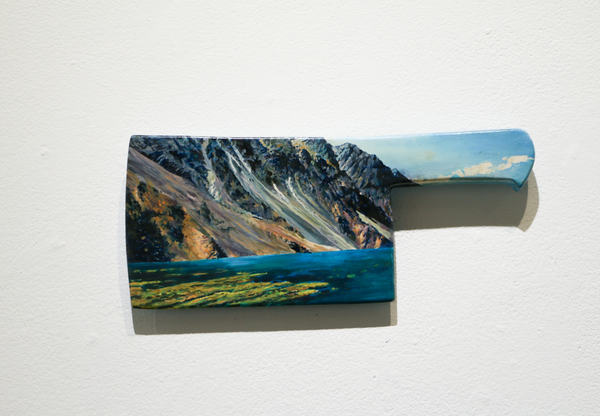
Adeela Suleman
I Will Meet You by the Water - 4
Metal cleeaver with enamel paint and hardener
5.50h x 12.50w in
2017
Aicon Contemporary presents A False Security, a group exhibition that examines the fragile, performative, and often illusory nature of protection in a world shaped by uncertainty. Whether physical, psychological, or social, security is frequently constructed through material forms such as masks, uniforms, helmets, and rituals. These forms are designed to shield the body and the mind, yet they also expose the anxieties that necessitate them. In A False Security, protection becomes a paradox: the mechanisms meant to defend us are also symbols of our precarity.
The promise of protection has always been bound to fear. As cultural theorist Paul Virilio warned, “When you invent the ship, you also invent the shipwreck.” Every mechanism of safety carries within it the possibility of failure, exposure, or chaos. Objects of defense are never neutral; they are artifacts of anxiety, power, and anticipation.
In G. R. Iranna’s Birth of Blindness sculptures, blindness becomes a paradoxical state; at once an act of faith and an imposed condition. Vision is surrendered in exchange for belief, obedience, or transcendence. Adeela Suleman’s helmets, stripped of their battlefield context and rendered ornamental, expose how violence and authority are aestheticized, normalized, and absorbed into everyday life.
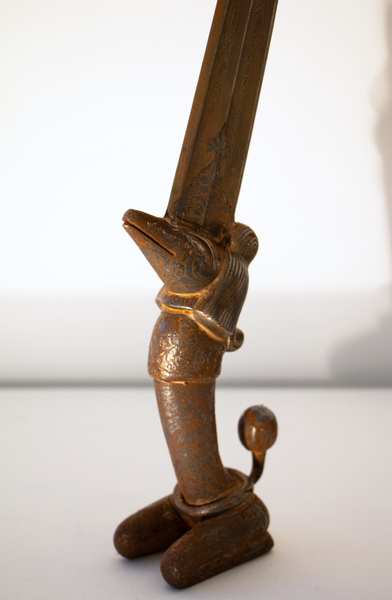
Siri Devi Khandavili
The Wear of Vigilance, 2015
Mixed metals and rust
18h x 2w x 3d in
As sociologist Ulrich Beck observed in his writing on the “risk society,” modern life is increasingly organized around anticipating disasters rather than preventing them. Katja Larsson’s hats and helmets hover between disguise and declaration, suggesting identity as a protective surface – something assumed, worn, and shed. Pulak’s gas masks confront the normalization of crisis, where survival gear becomes an everyday necessity rather than an exception.
Siri Devi Khandavilli’s work explores the psychological architecture of safety, how internal landscapes, memory, and ritual construct fragile sanctuaries within unstable worlds. Sudipta Das brings attention to bodily endurance and the human instinct to adapt, thus revealing how survival often requires negotiation rather than protection.
A False Security does not offer reassurance but acknowledges the uncertainties of safety. Together, these works challenge the conception of safety as a fixed state and instead define it as a continuously negotiated fiction. We are asked to consider the resistive qualities of vulnerability, and the line between protection and control.